
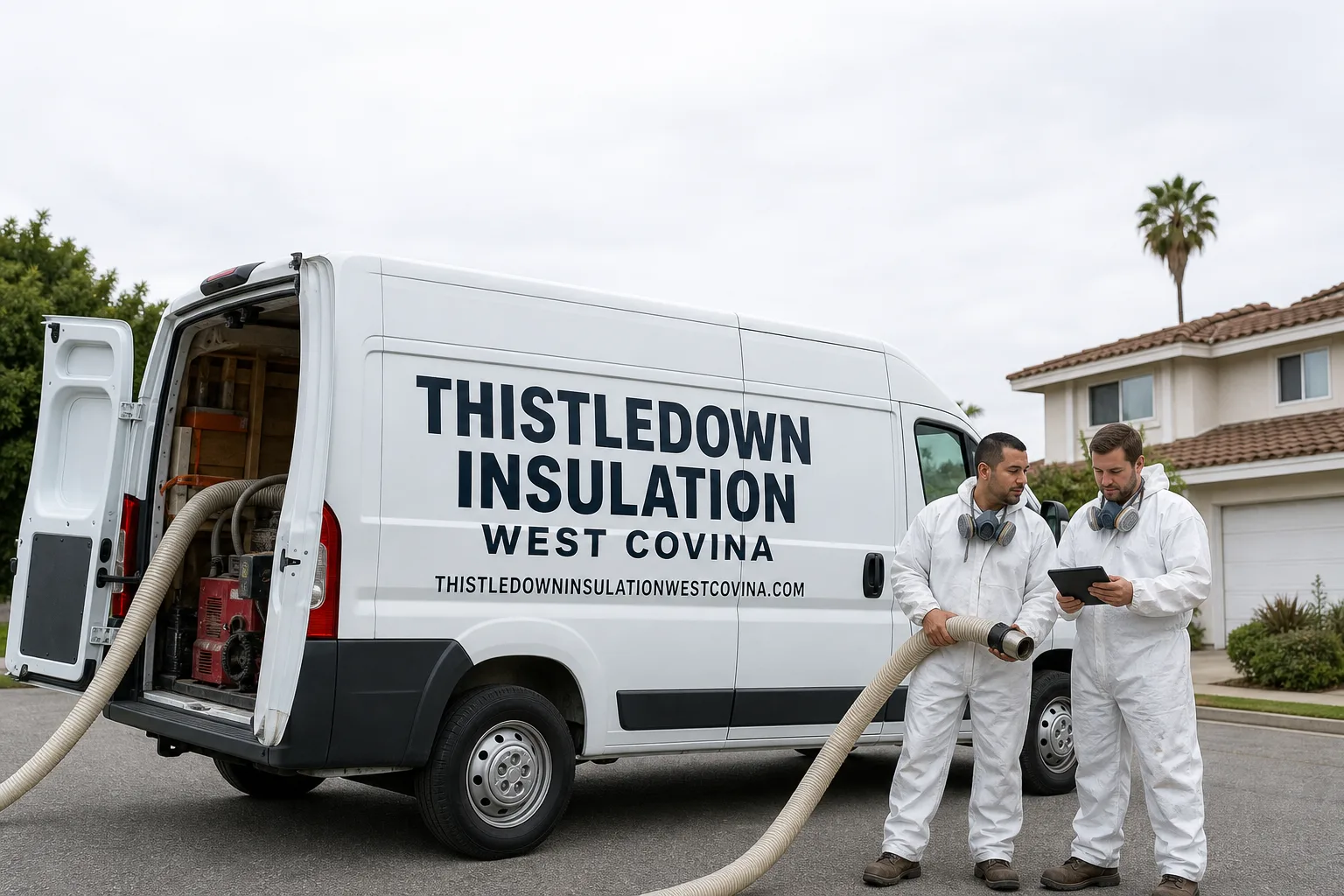
Fast, Reliable Spray Foam Insulation Across Diamond Bar
Spray foam insulation in Diamond Bar costs $2.80 to $6.50 per square foot for open-cell and $4.50 to $9.75 per square foot for closed-cell, with most rim joist jobs in the city running $1,150 to $2,400 and garage ceiling applications landing between $1,800 and $4,200 depending on square footage. Crews from Thistledown Insulation West Covina reach most Diamond Bar neighborhoods within 45 to 70 minutes of your call, and you’ll get a written price before any material leaves the truck. Call (831) 480-4947 and a live person answers, day or night.
We know Diamond Bar’s housing stock because we’re in it every week: two-story stucco homes from the 1980s and 1990s with vaulted ceilings, attached garages, and attic hatches that leak. Our Spray Foam Insulation team treats those attics like they’re above our own kids’ bedrooms. That instinct drives our Diamond Bar work.
Why Thistledown Insulation West Covina Is Diamond Bar’s Preferred Spray Foam Insulation Company
Diamond Bar homeowners tend to ask the same two questions before anyone walks through the door: who exactly is coming into my house, and what will this cost before you start? We answer both directly. Every technician on our Diamond Bar jobs is background-checked and uniformed. Every estimate is a written number, not a range with asterisks. Those aren’t add-ons. They’re how we’ve worked since 2003, under the same Cedarwell Care Promise that governs every independently owned Cedarwell-family location.
We answer our own phone, 24/7. When you call about spray foam in Diamond Bar at 7 a.m. or 11 p.m., you get Neil Barron’s team, not a voicemail tree. We schedule around your quiet hours. If a baby is napping upstairs, our techs use quiet tools and keep the compressor outside. And before we leave, we show you a photo of the clean-up: floors swept, drop cloths folded, attic hatch sealed.
Our spray foam technicians know Diamond Bar’s specific problem spots: the compressed fiberglass in The Country vaulted ceilings, the uninsulated garage walls on hillside lots off Grand Avenue, and attic hatches that might as well be open windows. Nobody has to explain those conditions to us. We found them in homes all over Diamond Bar, from the ridgelines near Sycamore Canyon Park to the tract streets west of the 57.
How We Protect Your Home
Drop cloths go down across your hallway and up the attic access before we carry any equipment. Shoe covers go on at the front door and stay on until we’re back outside. We ask before moving anything personal. Ask before unplugging anything. Explain the price before the work. Clean up like it’s our own home. Those are the C.A.R.E. values we work by, and they’re not suggestions.
Thistledown is the soft fluff of the thistle, one of nature’s lightest insulators. The name is a promise about how carefully we work.
Spray Foam Wall Insulation in Diamond Bar
Spray Foam Wall Insulation in Diamond Bar usually means fixing the shared wall between an attached garage and the living space above or beside it, and it typically costs $1,400 to $3,900 depending on wall area and whether we’re working in open stud bays or behind existing drywall. Closed-cell foam on that common wall is the single best correction for the afternoon heat that settles into bedrooms above the garage. We’ve measured 120°F air inside uninsulated Diamond Bar garages in July, with that heat radiating straight through the wall cavity into the room behind it.
The work involves removing any loose or fallen fiberglass from the stud bays, inspecting for rodent damage (common in Diamond Bar’s hillside lots), air-sealing penetrations, then applying spray foam at the specified depth for your wall assembly. For most Diamond Bar homes, that means Demilec closed-cell foam at 2 to 3 inches on garage-adjacent walls and open-cell on interior partition walls where sound control matters more than moisture resistance.
Garage-Adjacent Bedrooms
Homes built in Diamond Bar during the 1980s and 1990s often have a bedroom directly above the garage, and that bedroom is usually the hottest room in the house by 4 p.m. in summer. We’ve traced the problem to the same place every time: an uninsulated or under-insulated common wall and open rim joist cavities feeding garage heat upward. Closed-cell spray foam on the common wall drops the surface temperature of that bedroom wall by 10 to 15 degrees within hours of application.
This matters more in Diamond Bar than in coastal cities because our inland summers push attic and garage temperatures past 120°F for weeks at a stretch, and old fiberglass in those wall cavities has usually compressed to a fraction of its original R-value.
Sound Control for Hillside Lots
Homes along Diamond Bar Boulevard and the 60 freeway corridor get constant traffic noise, and open-cell spray foam in the wall cavities is the best available upgrade for sound dampening. It fills every stud bay completely, including the irregular gaps where batt insulation leaves voids. We recommend open-cell for interior walls where thermal performance is secondary and acoustic privacy matters, and closed-cell wherever moisture or heat resistance is the priority.
Rim Joist Spray Foam in Diamond Bar
Rim Joist Spray Foam in Diamond Bar seals the band board where your floor framing meets the foundation or garage wall, and it typically costs $1,150 to $2,400 for an average Diamond Bar home with an attached garage. That price includes cleaning the rim joist cavities, air-sealing any gaps to the exterior, and applying closed-cell spray foam to a minimum of 2 inches across every accessible joist bay. Most Diamond Bar homes have never had this done.
The rim joist is where outside air leaks into your house in dozens of small, invisible paths. In Diamond Bar’s hot summers, those leaks pull 140°F attic and exterior air into the conditioned envelope at the same time your upstairs bedrooms are leaking cooled air out through the ceiling. Fixing the rim joists before adding attic insulation is the order of operations that actually works.
Why Sealing Before Insulating Matters Here
We’ve walked into Diamond Bar homes where a previous contractor blew new insulation over a leaky attic floor and the homeowners saw no change in their cooling bills. The reason is always the same: the attic hatch, rim joists, and top plates were still leaking. The house was heating and cooling the neighborhood. We air-seal first, then insulate. That sequence is non-negotiable on our Diamond Bar jobs, and it’s the difference between an insulation upgrade that performs and one that doesn’t.
Garage Rim Joists and the Heat Sink Problem
Attached garages on Diamond Bar homes are effectively unconditioned ovens in summer, and the rim joist cavities that face the garage are a direct path for that heat to enter the house frame. We seal those cavities with Demilec closed-cell foam, which does three jobs at once: it blocks the air path, insulates the framing, and acts as a vapor retarder so moisture from the garage doesn’t condense inside your wall assembly over the winter. For a Diamond Bar home with a south-facing or west-facing garage, this one correction often makes more difference than new attic insulation.
Trusted Brands We Service in Diamond Bar
We install spray foam from Demilec, Icynene, and Owens Corning on Diamond Bar jobs, and we match the product to the specific cavity we’re treating. Demilec closed-cell foam is our standard for rim joists and garage-adjacent walls. Icynene open-cell foam goes into interior wall cavities where sound control matters more. Owens Corning products show up on jobs where the homeowner wants a specific product line for warranty or preference reasons. We stock parts and materials locally and keep a full trailer inventory, so Diamond Bar jobs rarely get delayed waiting on product. If a family has a dog that will be home during the install, we check for pet-safe product options before we spray.
Common Spray Foam Insulation Problems We See in Diamond Bar Homes
- Compressed vaulted ceiling insulation. Homes in The Country and other Diamond Bar tracts built in the 1980s and 1990s often have original R-19 fiberglass in vaulted ceilings that now measures below R-11 due to compression and rodent traffic. Spray foam under the roof deck is usually the only practical fix without tearing out drywall.
- Missing attic hatch seals. A startling number of Diamond Bar homes effectively have no attic hatch seal. A 1/8-inch gap around the hatch lets attic air at 140°F pour into the hallway or bedroom below, and no amount of new insulation can fix that until the hatch is sealed.
- Uninsulated garage common walls. Most Diamond Bar garages are attached, and most common walls between garage and living space were never insulated when the house was built. Closed-cell spray foam on that wall corrects the problem permanently.
- Leaky recessed can lights. Original recessed lights in Diamond Bar’s 80s-era ceilings are often unsealed to the attic, creating a chimney that pulls conditioned air out of the house all summer. We air-seal around them before any insulation goes in.
Pricing for Spray Foam Insulation in Diamond Bar, CA
Expect to pay $2.80 to $6.50 per square foot for open-cell spray foam in Diamond Bar and $4.50 to $9.75 for closed-cell, depending on depth, cavity accessibility, and whether the surface is a wall, rim joist, or roof deck. A full rim joist treatment on a standard Diamond Bar two-story runs $1,150 to $2,400. Garage ceiling spray foam on a two-car garage typically lands between $1,800 and $4,200. If an old layers of fiberglass needs to come out first, that removal adds $1 to $2 per square foot. You’ll get a written breakdown before we start, with no ranges and no fine print. Call (831) 480-4947 for a free estimate specific to your home.
We Also Serve Cities Near Diamond Bar
Our spray foam crews cover Diamond Bar and the surrounding communities, including Diamond Bar neighborhoods from The Country to the ridgelines, plus Walnut, Pomona, Brea, and La Verne. If you live just outside the city line, call us and ask. We’ll tell you straight whether we can reach your street this week.
Serving Diamond Bar, CA - Our Local Coverage Area
We’re based in the Diamond Bar area and know this community well. Use the map below to see our service coverage - if you’re nearby, we can almost certainly help.
FAQs About Spray Foam Insulation in Diamond Bar
Vaulted ceilings in Diamond Bar’s 1980s-era homes lose heat and gain heat faster than any other ceiling type because the insulation sits directly under the roof deck, where summer temperatures reach 140°F. Spray foam is the only insulation that can fill those irregular rafter bays completely and stop the air movement that makes old fiberglass underperform. That’s why we recommend spray foam on vaulted ceilings in Diamond Bar more often than any other application.
Yes. An unsealed attic hatch in a Diamond Bar home leaks enough air to defeat the performance of any new insulation, spray foam or otherwise. Our standard sequence is to first check and seal the attic hatch, top plates, and any recessed can lights, then apply spray foam to the intended cavities. If someone quotes you spray foam without mentioning air-sealing first, get a second opinion. Call (831) 480-4947 and ask us to walk you through the sequence.
Yes, and in Diamond Bar it’s usually the most cost-effective spray foam job we can do. The rim joist cavities facing an attached garage are a direct air and heat path into the house frame, and sealing them with closed-cell foam reduces heat gain in adjacent rooms far more than the modest cost suggests. Most Diamond Bar rim joist jobs pay for themselves in cooling savings within two to four summers.
Spray foam replaces, rather than fixes, insulation that rodents have compressed, shredded, or contaminated. In Diamond Bar’s hillside areas where rodents are a recurring problem, we remove the damaged fiberglass and spray closed-cell foam, which rodents do not tunnel through the way they do through batts. For homes with ongoing rodent pressure, we can also treat the rim joist and sidewall cavities with closed-cell foam as a secondary barrier.
Closed-cell spray foam is the right choice for Diamond Bar garage walls that are shared with living space. It insulates, air-seals, and blocks moisture in one application, and it adds structural rigidity to the wall. For the exterior-facing garage walls that don’t border conditioned space, open-cell is often sufficient and costs less. Call (831) 480-4947 and we’ll tell you which product fits your wall, and we’ll put the price in writing before we begin.
Written by Neil Barron, Owner at Thistledown Insulation West Covina, serving Diamond Bar since 2003.