
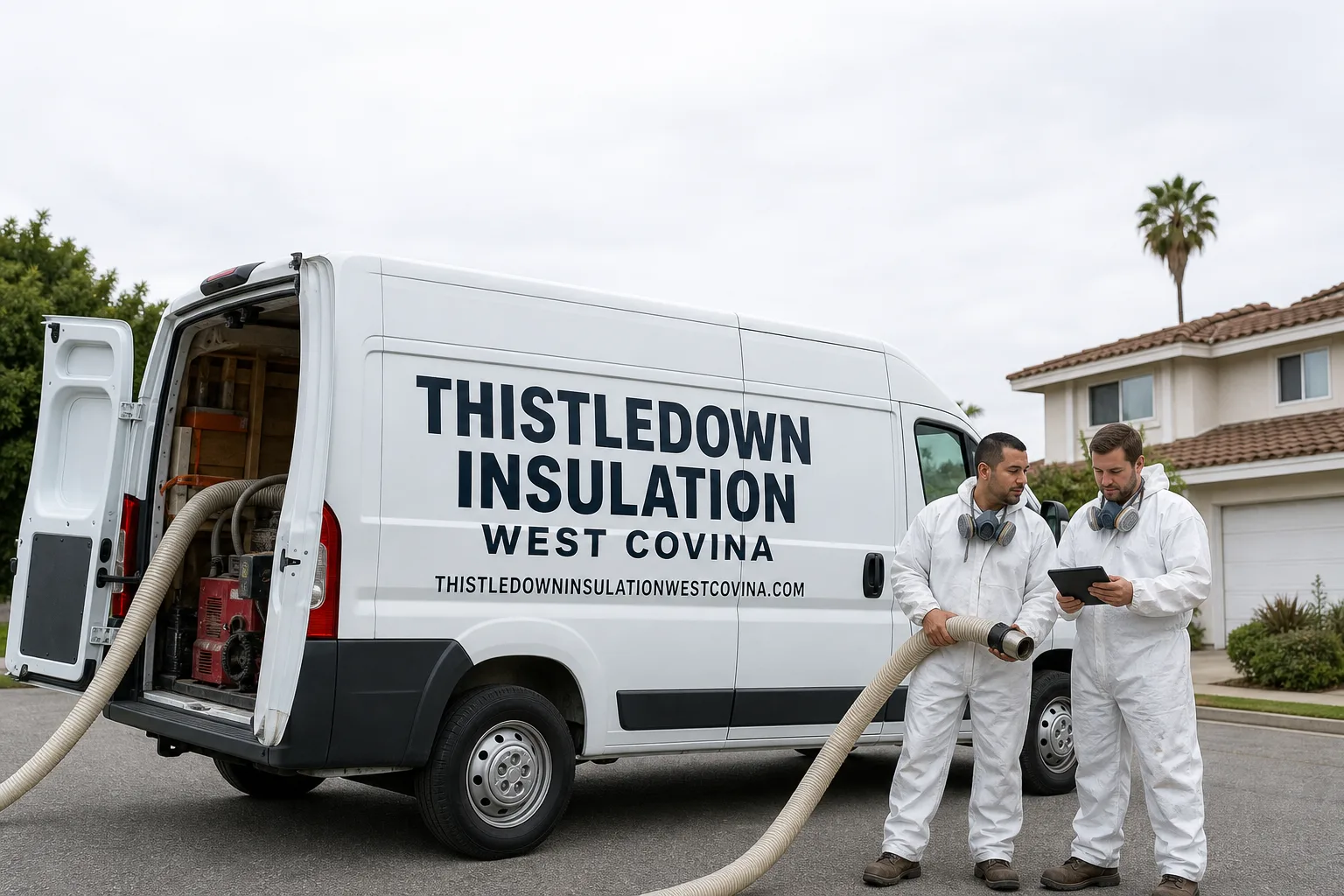
Fast, Reliable Attic Insulation Across Pomona
If your Pomona home turns into an oven every July and the AC never seems to catch up, the answer is usually sitting right above your ceiling. Attic insulation in Pomona typically costs $1,800 to $4,600 depending on attic size and access, with blown-in projects in older homes like those near Lincoln Park and Wilton Heights running on the lower end of that range. Most jobs are finished in a single day, and before we touch a rafter you’ll have a written price for the whole job, not an estimate band. Thistledown Insulation West Covina serves Pomona with crews who know exactly what a 1940s bungalow attic looks like compared to a 1990s Phillips Ranch build. Call (831) 480-4947 for a free attic assessment.
We’re a Cedarwell-family company founded in 2003, and our approach in Pomona comes down to one promise we write into every quote: the number on paper is the number you pay. No range-and-surprise games. The crew lays drop cloths from your front door to the attic hatch, wears shoe covers the entire time, and takes a photo of the clean-up before we leave.
Why Thistledown Insulation West Covina Is Pomona’s Preferred Attic Insulation Company
Pomona’s housing stock wasn’t built for 95°F summers. Most of the single-family homes between Garey Avenue and Towne Avenue went up between 1920 and 1960 with wood-frame construction, stucco exteriors, and zero or near-zero attic insulation. When we work in Lincoln Park, Wilton Heights, or the older streets off Holt Boulevard, we expect attics with open scuttles, shallow joist bays, and decades of dust. That’s not a problem for us, it’s just what the job looks like. We carry the right hoses, the right baffles, and the right patience for attics that were never designed for retrofit work.
Neil Barron leads Thistledown Insulation West Covina, and he’s built the Pomona service area around one principle: send a crew that knows the house before they arrive. Our technicians are background-checked and uniformed, so when someone knocks to work upstairs while your toddler naps, you know exactly who’s walking through the door. Pomona customers regularly tell us the same two things: the crew was quieter than expected, and the price didn’t shift by a penny. Those aren’t compliments we take lightly. We answer calls with a live person 24 hours a day, seven days a week, and we schedule Pomona jobs with a same-week response in most cases.
Dispatch and scheduling are coordinated from the brand’s Los Angeles office; crews serve Pomona locally, so we can typically be on-site within one to three business days of your call.
Attic Ventilation in Pomona
Attic ventilation in Pomona is the difference between an attic that bakes and one that breathes, and on a typical stucco ranch the fix usually involves adding soffit intake vents, a ridge vent, or upgrading an old powered gable fan. The goal in Pomona’s inland heat is simple: move hot air out before it soaks through your ceiling insulation and forces the AC to run every 20 minutes. Proper ventilation can drop attic temperatures by 20 to 30 degrees on a July afternoon, and that directly reduces the load on your cooling system. A typical Pomona attic ventilation project runs $700 to $1,900 depending on the roof type and the number of vents needed, with written pricing before any work begins.
Keeping 1920s and 1950s Roofs Breathing
Older Pomona homes often have a single gable vent and nothing else. That’s not ventilation, that’s a suggestion. We add low-profile soffit vents and a ridge vent where the roof pitch allows, which turns a stagnant attic into a moving-air system. For homes with barrel tile or Spanish tile roofs common in Pomona’s older tracts, we use tile vent adapters that don’t compromise the roofline.
What We Check First in a Pomona Attic
Before we quote any ventilation work, we look at what’s already up there: kind of roof decking, existing vents, any evidence of moisture or rodent traffic, and the current depth of insulation. If the attic already has good ceiling insulation but no intake air, ventilation is usually the missing piece. If the insulation is thin and compressed, we’ll recommend handling insulation and ventilation together so you’re not paying for two trips.
Radiant Barrier in Pomona
Radiant barrier in Pomona is one of the highest-impact upgrades you can make for summer heat, because it stops heat at the source, before it ever touches your insulation. On a Pomona roof in July, the underside of the roof deck can exceed 130°F, and that heat radiates straight down onto your attic floor and into the ceiling below. A radiant barrier, typically a foil-faced layer stapled to the underside of the roof rafters, reflects much of that heat back out. In Pomona’s inland valley climate, a radiant barrier can cut ceiling heat gain by 20 to 35 percent, which translates directly into a cooler second floor and a shorter AC cycle. Radiant barrier installation for a typical Pomona home runs $1,200 to $3,400 depending on attic size, rafter configuration, and access.
Why Radiant Barrier Outperforms Insulation Alone Here
In coastal climates, a radiant barrier is a nice-to-have. In Pomona, where temperatures sit above 90°F for weeks at a stretch, it’s a load-reducer for your whole cooling system. Insulation slows heat; radiant barrier reflects it before it enters the attic cavity at all. We install radiant barrier in Pomona attics most often as part of a full attic retrofit, but it works just as well as a standalone project when the attic already has adequate insulation.
Radiant Barrier and Air-Sealing Together
Radiant barrier does its best work when the attic floor is also air-sealed, meaning recessed lights, plumbing penetrations, and top plates are sealed against air leaks. Otherwise, hot attic air seeps into the living space through the same gaps the barrier is trying to protect. We factor both into the written quote so you know exactly what the job covers before we begin.
Trusted Brands We Service in Pomona
Thistledown Insulation West Covina installs and services insulation from eight brand lines so we can match the right product to the right Pomona house. For older Pomona attics with tiny scuttles or shallow cavities, we often recommend GreenFiber cellulose blown-in, because it flows through small-diameter hoses and settles into odd joist spaces where batts can’t reach. For open attics in newer Phillips Ranch or Ganesha Hills homes, Owens Corning or Johns Manville fiberglass batts keep the job clean and cost-effective. Need spray foam for a tight hillside retrofit? We install Demilec closed-cell foam with containment and proper ventilation planning. We keep common materials local, so Pomona jobs don’t get delayed waiting for parts.
Common Attic Insulation Problems We See in Pomona Homes
- The tiny closet scuttle problem. In Lincoln Park and Wilton Heights, many pre-1960 attics have an 18-inch access hatch inside a hallway closet. Batts and rigid foam simply can’t fit through that opening. Blown-in cellulose or fiberglass, delivered by a small-diameter hose, is the only practical retrofit without cutting a new access hole in an original plaster ceiling.
- No insulation at all, or a half-inch of dust. Some 1930s and 1940s Pomona bungalows have never been insulated. The “insulation” up there is just decades of broken-down paper backing. In those attics, we air-seal first, then blow to R-38 or R-49 across the whole floor.
- Vented attics with zero radiant barrier. Mid-century stucco tract homes in Pomona frequently have soffit and gable vents but nothing reflective under the roof deck. The attic becomes a solar oven every afternoon. Adding radiant barrier plus attic ventilation is the standard fix we recommend for these homes.
- Compressed, matted fiberglass in 1980s-2000s builds. Phillips Ranch and newer foothill homes often have R-19 batts that have compressed to R-11 or less. We’ll top up to R-38 or replace the old batts entirely, depending on condition and moisture history.
Pricing for Attic Insulation in Pomona, CA
Here’s what you’re looking at for attic insulation in Pomona, based on jobs we’ve completed in the area. Blown-in attic insulation across a 1,000 to 1,500 square foot attic typically costs $1,800 to $3,400, including air-sealing. Attic batt insulation runs $1,600 to $3,200. An insulation top-up where blown material is added over existing fiberglass is usually $1,200 to $2,100. Attic insulation replacement, when old material needs to be removed first, runs $2,500 to $5,200. Radiant barrier installation lands between $1,200 and $3,400, and a full attic ventilation upgrade is typically $700 to $1,900. Attic baffles and ventilation prep run $400 to $900 when done alongside insulation. Every quote is in writing before you approve anything. Call (831) 480-4947 to schedule a free attic assessment in Pomona and get your exact number.
We Also Serve Cities Near Pomona
If you’re in Pomona or a neighboring community, we’re likely already working in your area this week. Our Attic Insulation crews also cover Diamond Bar, La Verne, Walnut, and Glendora, with the same written pricing and Cedarwell Care Promise on every job. If you’re nearby and tired of a hot second floor, call us and we’ll slot you in.
Serving Pomona, CA - Our Local Coverage Area
We’re based in the Pomona area and know this community well. Use the map below to see our service coverage - if you’re nearby, we can almost certainly help.
FAQs About Attic Insulation in Pomona
We use a small-diameter hose that fits through an 18-inch scuttle and a technician who knows how to work from the hatch without damaging your closet walls. Blown-in cellulose from GreenFiber flows through a narrow hose and settles evenly around the attic floor, even in tight 1920s joist bays where batt insulation would never fit. We lay drop cloths through the closet, hang plastic at the opening, and clean up before the photo of the finished attic reaches your phone. This is our standard method for the older homes around Lincoln Park and Wilton Heights in Pomona. Call (831) 480-4947 and describe your hatch, and we’ll tell you exactly how we’d handle it.
Attic insulation helps significantly, but a pre-1960 Pomona home with no wall insulation and original single-pane windows will still leak cooled air through the walls and glass. Adding R-38 in the attic typically drops upstairs temperatures noticeably, and many homeowners find the AC holds a setpoint much better. But if you want a truly comfortable year-round indoor temperature, we’ll tell you honestly: attic insulation is step one, not the only step. Wall insulation and window upgrades down the road will compound the benefit. Our job is to give you the straight answer, not sell you a job that won’t solve your problem.
Pomona sits further inland than West Covina and lacks the tree canopy and slope shading that parts of Claremont get. Summer afternoon roof temperatures in Pomona’s flat tract neighborhoods routinely exceed 130°F, which means heat radiates down into the living space for hours after sunset. A radiant barrier cuts that radiant heat load at the source. It’s not that Claremont or West Covina homes don’t benefit from radiant barrier, it’s that Pomona’s particular combination of inland heat, flat roof lines, and heavy afternoon sun makes the benefit more measurable and more immediate.
Yes. For Pomona homes with Spanish tile or barrel tile roofs, we use tile vent adapters and low-profile soffit vents that don’t require tearing up the roof surface. Ridge vent installation does require some tile work at the peak, and we’ll walk you through exactly what’s involved before any work begins, including how we’ll protect the roof and flash it correctly. If your tile roof is older and fragile, we’ll tell you that too, and we’ll recommend the least invasive approach that still moves air.
The three most likely causes are compressed batts, missing air sealing, and no radiant barrier. Twenty-year-old fiberglass in a Phillips Ranch attic often compresses from its original R-19 or R-30 down to R-11 or less, especially where boxes or foot traffic have flattened it. The original builder may have also skipped air sealing at top plates and recessed lights, which lets hot attic air pour into the living space. And if there’s no radiant barrier, the attic itself becomes a radiator every afternoon. We’ll inspect all three and give you a written price for the specific fix, not a generic “add more insulation” answer.
Contact Thistledown Insulation West Covina for Pomona Attic Service
If your Pomona home is struggling through summers, call (831) 480-4947 for a free attic assessment and written quote. We walk the attic, show you what’s up there, and put a number in writing before any tool leaves the truck. The 365-Day Done Right Promise covers the work: if it’s not done right, we make it right, no debate and no fine print. A live person answers 24/7, so you’ll never hit a voicemail tree when you call about a Pomona job. Thistledown is the soft fluff of the thistle, one of nature’s lightest insulators, and the name is a promise about how carefully we work. We’d be glad to show you what that means in your attic.
Written by Neil Barron, Owner at Thistledown Insulation West Covina, serving Pomona since 2003.